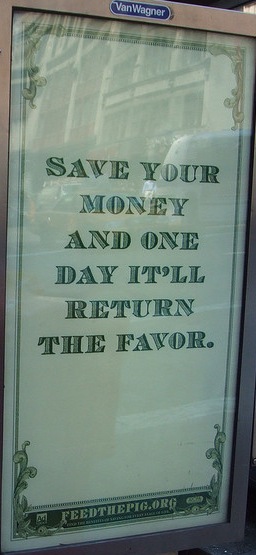
Save your money and one day it'll return the favor. Photo: Eliana on Flickr.
College students are generally living on their own, and living within a budget, for the first time in their lives. Learning to manage money on the tight budget of a college student may be challenging at first. However, with some practice, ramen noodle eating students will discover more ways to save money than just limiting their diets to ramen.
One way that college students can save money is to take advantage of discount car insurance for students from their auto insurance carrier. Most auto insurance companies offer discounts to college students simply because they are students! Also, your car insurance company may offer additional discounts for low mileage driving.
Check with your auto insurance provider to find out the discounts they offer on car insurance for students. Also, ask about any additional discounts they may offer for maintaining good grades.
Buy Used Textbooks, or Better Yet, Rent Them.
Textbooks are a major expense for most college students. Some books may cost well over a hundred dollars. On a college student’s budget, purchasing new textbooks is often not even an option.
In some cases, if you get to the library early enough before classes start, you may be able to check out the textbook to tide you over for a few weeks until one may be obtained.
Even if your parents are paying for your textbooks, buying new textbooks is simply a waste of money. New textbooks cost a lot of money, and you do not recoup that cost when you sell them at the end of the semester or quarter.
You will only recover a fraction of what you paid for the new textbook at resale time.
If at all possible, buy used textbooks or rent textbooks. Buying used books is not always an option, particularly when a newer edition is released and the professor requires that the newest, most up to date version of the book be purchased.
However, companies like Chegg.com will rent textbooks for a fraction of the cost of purchasing them.
Do Not Apply For Credit Cards
Many major credit cards target the college student market for their products. These companies know exactly how to market to college students by giving away cool gadgets, tee shirts and other goodies for applying for their cards.
Even if you don’t think you will qualify for the card, do not apply for any credit cards while you are still in school. Chances are, you WILL get approved for that card that offers the free iPhone when you apply. When you get the card, you begin a cycle of using the card without knowing where the money will come from to pay the bill.
If you are fortunate enough to have some type of employment to supplement your grants and loans, you may find that a majority of your income is eventually going to pay credit card bills.
Once you apply for and get one credit card, getting the next one, and then the next one… gets easier and easier, particularly if you manage to pay the minimum payments on time. If you do this, you are simply setting yourself up for issues in the future.
Miss or be late on one payment and that great introductory rate of 3% jumps to a rate as high as 30%, and then you find that you are simply paying interest each month that you make that minimum payment. The balance grows and grows because now you are accustomed to using the card - even when you know you cannot really afford a purchase.
Eventually, you find yourself in “credit card hell.” At that point, you may be as much as $30,000 or $40,000 in debt - and you are not even out of college yet! Much less gainfully employed.
Do yourself a favor and wait until you are finished with school and at least on your first job before buying into the credit card “dream.” Don’t spend your future away while you are still attempting to obtain your education.
Write Down and Analyze Everything You Spend Each Month
Keeping track of what you spend and how you spend it is the greatest deterrent for wasting money. If you evaluate your monthly spending and, say you find that you spent over 40% of your expenditures on partying, it will be much easier to change your behavior and stay within your budget during the next month.
In addition, when you see your spending habits written down in black and white, you cannot deny or make excuses for your spending. When you are forced to see what you are spending, and where you are spending it, you have to face the reality of where your money is going. Once you have a grasp on your spending, changing your spending habits is much easier to do.
Learn to Cook and Use Your Meal Plan
If you have a meal plan built into your dorm charges, learn to use it wisely. Take plastic containers and bags to the cafeteria with you and stock up food for later. Inevitably, you will need to munch while studying or writing that paper.
Why not use your meal plan card to purchase meals and save the food for later when you have leftovers? Meal plan cards are already paid for, in most cases, and you are not spending actual cash as you would do if running to the chips and candy machines when you feel the need to munch.
In addition, learn how to cook. If you have access to a hot plate or microwave, experiment with all of the culinary delights you are able to create with your limited resources.
Cooking is much cheaper than eating out, no matter what you eat. Learning to cook is one of the best gifts you could give yourself to foster self-sufficiency and to save money, as well.
Explore Entertainment Alternatives
As a college student, forgo the cable in your apartment or dorm room. In college, you will find that you spend a great deal of time with friends, studying and otherwise engaging in social activities.
Your cable-watching time is significantly reduced, so don’t bother spending the extra money to pay a cable bill.
You do not need the extra monthly expense and there are several ways to watch your favorite programs that will not cost you a dime. Hulu offers the vast majority of network television shows over the Internet - for FREE!
Amazon.com sells downloadable episodes of just about every series for around $.99. With Pandora, you can listen to all of your favorite music over the Internet - for FREE! Buy your CDs used from Amazon.com for a fraction of the cost of buying new CDs.
And don’t forget YouTube. You can get hours of free entertainment just watching the crazy kitty videos on YouTube.
Guest post by Sean Hopcraft, who is a Financial Representative at Northwestern Mutual Financial Network in St. Petersburg, Florida www.northwesternmutual.com



No Comments
No comments yet.
Sorry, the comment form is closed at this time.