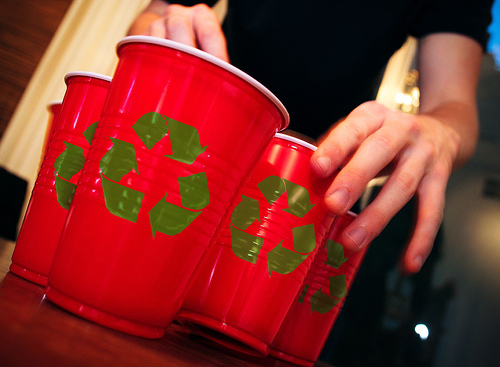
Photo courtesy of e-magic on Flickr.
In the interest of ensuring that our planet remains green and productive for our future generations, we all need to use less of natural resources and recycle whenever and wherever we can. While many people have successfully incorporated recycling as a way of life in urban homes, at work we still tend to waste.
Here are several recycling tips that’ll help you save resources at the workplace.
Save On Office Stationery
Employees tend to use office stationery freely since they’re not directly paying for it. Commodities such as paper, paper clips, pens, and staples, are all used indiscriminately. By exercising a little care, we can recycle most products.
Paper is an expensive commodity; the more paper we waste, the more trees we’ll have to cut to make more paper.
- Avoid printing letters and documents; use emails to manage your communication.
- Print and write on both sides of a sheet of paper. Print only what you need to; delete unnecessary email forwards and empty pages.
- Hand over all your used paper to a paper-recycling unit. Many useful objects can be made out of paper.
- Pool together sheets that have been used on one side; you can use these for printing, or you can make notepads out of them.
- Reuse used envelopes; paste paper over stamps and addresses. Buy envelopes made out of recycled paper so that fresh paper is not wasted.
- Donate large drawing sheets that’ve been used on one side to schools for painting classes. You can also use them as flip charts during meetings.
- Use paper clips instead of staples. You’ll be surprised at these statistics: if a single employee uses a paper clip instead of a steel staple a day, about 60 cars of steel can be saved in a year.
- Use fountain pens that use ink instead of the convenient plastic gel pens. You can help avoid the use of plastic.
- If you must use plastic gel pens, ensure that you use a pen until it dries out. Do not use multiple pens and lose them all.
Save Electricity
Electricity is a blessing that we often misuse. Many areas of the world don’t have regular electricity and have to make do with candles. Save electricity whenever you can.
- Turn off lights, fans and all electrical and electronic equipment when you leave a room.
- Turn your monitors off when you’re not using them. You’ll be saving 66 percent of your computer’s energy by doing so.
- Switch off lights in your office during the night. Keep only security lights on.
- Elevators use a great deal of power when they move up and down. Use the stairs and save on this power.
- Switch off your mobile phone charger when you’re not charging your mobile anymore. If you keep the charger on, you’ll be drawing energy and contribute to approximately 77 - 154 pounds of carbon dioxide each year, something that can be completely avoided.
- Ensure that the thermostat that manages the heating and cooling is serviced and changed regularly.
- Use dark colored blinds on windows to reduce the heat in summer and save on air conditioning costs.
Recycle Plastic
Plastic is inorganic and cannot be destroyed. Huge landfills of plastic bags and items are clogging the earth in urban areas, becoming a toxic biohazard for the nearby population. Our once pristine oceans now have miles of floating plastic, a result of our enduring obsession with this vile creation. A single person consumes 290 plastic bags every year and these are just the average statistics. In real terms, the usage is probably much higher.
- As an individual, take a stand and say “no” to plastic bags; use only cloth bags when you go shopping.
- Use flasks or metal reusable hiking bottles for your daily water supply instead of plastic bottles.
- Recycle plastic bottles; by recycling each bottle, you’ll be conserving the energy required to light a 60 watt light bulb for 6 hours.
- Use a water filter or water purifying system in your office to prevent the use of bottled water.
- Replace plastic cups with biodegradable paper cups made of recycled paper.
- Pack you lunch in a brown paper bag and resist the temptation to pick up a sandwich packed in plastic.
- If you don’t make your own lunch, take a good quality container to the sandwich shop and ask them to pack your sandwich or salad in it.
Use Less Water
Many areas of the world suffer from severe water shortage. Many of our great rivers are polluted. Our future generations might find it tough to find water for their regular use, forget drinking water.
- Use only as much water as you need for making tea, noodles, or instant soups in the office. If you have drained more water, store it in the pantry for future use.
- Wash your cups and plates in a large bowl of water, instead of directly under the running tap. This will save a great deal of water.
- If your office has a shower, keep the shower turned off when you soap your body. Turn the water on only when you need to rinse.
- Use your toilet’s flush just once after you are done. Each time you press the flush button, several gallons of water are used.
- Do not set your office lawn and garden sprinkler system on automatic; not all plants require the same amount of water. Use a watering can and spout to water plants individually.
- Get office cars cleaned with a wet cloth and use water to wash them only when they’re very muddy.
Recycle Organic Waste
Did you know that you can create your own compost by recycling organic waste from the office?
- Ensure that employees don’t throw away apple cores, banana peels, and nutshells. Collect them in a compost pit in the office backyard and donate the compost to public gardens. In a recent Friends of the Earth initiative, 1680 kilos (about 3,704 pounds) of compost were collected by several offices in the UK.
Author Bio
John Smith manages an online nursing uniforms store offering a wide range of scrub top, pants, and lab coats.
