Articles Written Within Areas of Study

Interview with a Legal Assistant – Misconceptions and Continuing Education

February 4th, 2011 by Sarah Ward

For the last few Fridays we have been publishing an interview with a legal secretary from New York, Ellen Adams, to help give you an idea about what a legal assistant career is like. This vocation is expected to grow at a faster-than-expected rate, according to the Bureau of Labor Statistics, making it a reliable career choice for the future.

  1. Are there other fields related to law that students may want to consider?

    Photo: legalaction.ca

    Well, the paralegal field is another option. I feel it was developed because long ago due to the fact that the first year associates complained about not wanting to do the “grunt work.” I consider that a “bridge” between legal secretarial and deciding whether or not you want to go to law school and become an attorney. Paralegals need the same skills – attention to detail, great time management skills, diplomatic skills, etc., to be successful in that area of legal work. Paralegals also need a strong foundation in legal concepts and vocabulary, along with technical training in specialized areas — such as corporate law, bankruptcy, intellectual property law, just to name a few areas of concentration. You need to develop the theoretical skills and receive the practical training necessary to get the job done successfully. Paralegals work under the supervision of an attorney and are able to perform all functions of a lawyer except giving legal advice. No matter what you decide, there is a lot to learn in the legal profession. Managing clerks, docketing (keeping court calendars for all attorneys in the firm) clerks, records management are also areas to consider. Each of these will require training. Some of these things can be learned on the job, but not all of them can be, and you are often better off taking any courses at the local college or university to learn all that you will need to successfully assist the attorneys. Many colleges and universities offer certificates and/or diploma programs that help you prepare for work in this capacity.

  2. Are there recommended continuing education opportunities for your profession?

    Yes and no. The same courses that I mentioned above will help you expand your knowledge of the law and what is required to assist an attorney effectively and efficiently. Taking continuing education courses in different areas (such as fundamentals of business law, licensing of intellectual property, or fundamentals of equal employment opportunity law, just as an example) will help you improve your interactions with the legal profession or within the firm that you might work, so I would say it definitely could not hurt. However, unless you make the decision to become a paralegal or legal specialist, the next step is law school. Other than that, you choose an area that interests you that may have absolutely nothing to do with law, and go on from there to pursue other fields in which you may have a strong interest. The one thing working at a law firm will do afford you the opportunity to see how it all works from the inside, and that will help you decide if you want to continue in your role as a secretary or move on to another career within law or outside of the law. Sometimes, it helps you decide that you are fine with “blooming where you are planted;” other times, you decide to choose another career path altogether. But you definitely will get an education no matter what you decide.

  3. What misconceptions do people have about being a legal secretary?

    I already knew that I didn’t want to be an attorney. … However, I was interested in law, so I chose the legal secretarial route. I thought it wouldn’t be too hard to do, but I was mistaken. It is hard, but it is definitely manageable. I think that some people can romanticize any profession, but it is tough work and, as I mentioned earlier, not for the faint-hearted. You need a thick skin. We are not talking Perry Mason or L.A. Law or Boston Legal here. Those are exaggerations, to say the least. It can be interesting, it can be enlightening, it can be (on a rare occasion) fun, but it is never dull and can be quite intense.

    All in all, it’s been an interesting career.

In case you missed it, here’s the first two parts of the blog mini-series.

Interview with a Legal Assistant – Advice, Challenges, and Preparation

January 28th, 2011 by Sarah Ward

For the next two Fridays we will be publishing an interview with a legal secretary from New York, Ellen Adams, to help give you an idea about what a legal assistant career is like. This vocation is expected to grow at a faster-than-expected rate, according to the Bureau of Labor Statistics, making it a reliable career choice for the future.

  1. What advice would you give a student considering a career in the legal field?
    Be prepared to study and work hard. It’s truly not for the faint-hearted. Even though we are in a so-called “electronic age,” there are fundamental skills that will help you to do the job effectively. You should be detail oriented, meticulous, flexible and diplomatic. Time management skills are crucial. It also helps to have a thick skin. Multi-tasking is a must, since you are often “switching gears” at a moment’s notice. You need to learn to be responsive and anticipate that things can and will happen when you least expect it to. Learn to listen and listen to learn.
  2. What is most challenging about your profession?
    Trying to avoid tedium and/or becoming bored. Once you master the basics, it can be a challenge to stay motivated. Unless you continue to learn and adapt, that can happen.

  3. In what way did your education prepare you for your career?
    I went to what was formerly called The Berkeley School, which is now called Berkeley College. It was specifically for the “secretarial sciences,” and I earned an associate’s degree (Associate in Occupational Studies or an A.O.S.), after successfully completing their 2 year secretarial program with a legal concentration. You had a choice of doing a general secretarial program, a medical secretarial program, or a legal secretarial program. To be honest, the legal secretarial afforded me an opportunity to earn a higher salary, and that definitely helped me decide which direction to move in.

In case you missed it, here’s the Interview with a Legal Assistant Part I - A Rewarding Day on the Job.

Popular Search Terms:

challenges in a legal careerchallenges legal assistantchallenges of an assistant,

Awesome Things College Professors Say

January 26th, 2011 by Sarah Ward

Sometimes college professors say the darndest things. One of your favorite back to school activities may be listening to awesome things that your college professors have to say. If you have a cool college professor, you’ve likely heard things like…

  1. “Don’t cheat in this class, you will fail this course and then you will die.” The first words of my class this morning. That woke me up. - Audrey
  2. “Our professor strapped a teletubby to a bouncy ball to show us how we can only view a certain part of the sky from different places on earth. Gotta love Discovering the Universe.” - Jessica Banks
  3. “In Kingship, I am the king. I love you. You love me…..we’re a happy family.” - Deecue‘s Government Teacher
  4. “Yesterday, my Math 1B GSI (Graduate Student Instructor) compared integration by parts to pirates and ninjas.” - feendaffaire
  5. “It may seem a silly reason to go to war, but put it in modern terms. Imagine if Michelle Obama ran off with Kim Jong Il. That would be….God that would be so weird…” - rycitycentral‘s Literature as Art professor on the Torjan War
  6. “I’m in intermediate microeconomics. My professor is using Harry, Ron, and Hermione as examples of different levels of productivity.” - theycallmeaviendha
  7. “So Harriet Tubman was — that was my hip by the way. I didn’t just fart in front of you guys.” - talkingshrimp‘s History teacher
  8. “Dear Students, Please consider using our office hours as an opportunity to learn. It feels lonely sitting in my office when nobody shows-up.” - confusedquark‘s Logic Systems professor
  9. “You’ve never seen Mickey Mouse stop a dialogue sequence to groom himself. But real mice WILL do that.” - nashhha‘s Neuropsychology professor
  10. “In today’s class, my professor said she would give anything in the world for two minutes to be in the mind of her cat.” - xphosho‘s Professor
  11. “Student: Is there a participation grade?
    Professor: No, I think that only rewards the bullsh!tters that drone on and on and on.” - yaej‘s Ethics and International Relations Class
  12. “What the hell is wrong with you guys? Why the hell are you depressed? Barely in your 20s! Be happy! You are young, beautiful, handsome, brainy, you have the world at your finger tips! These are your golden years. It is beautiful in this world; California weather, eh? God has blessed us! Be happy!” - arrajane‘s Professor Spyridakis
  13. “I’d like to live with Bill Murray.” - bccrayolamakher‘s Composition professor
  14. “If you haven’t found the textbook yet you guys might also want to try Wal-mart.com.” - fornowjustcarryon‘s professor
  15. “Facebook is the Internet meat market.” - lizshutterbug‘s professor, Dr. Phillips
  16. “I just wish I was younger. You wouldn’t be sitting there looking so complicated.” - casenpoint‘s professor Billy Turner
  17. “Facebook makes me feel like a pervy, voyeuristic old man and I don’t allow it in my class. However, if YOU have an addiction and needs to check it every 30 seconds, just put up your hands and explain to me and I will excuse you outside to check your Facebook or porn or whatever it is you need to do.” - anniesapphire‘s professor
  18. “Toast is appropriate for any meal.” - fistflight‘s Psychology of Gender professor
  19. “Citing yourself in a paper is like intellectual masturbation.” - witty-‘s writing professor
  20. “I will expect at least a few anecdotes of sledding on unusual objects…” - fistflight‘s poetry professor

Care to add to the list?

Popular Search Terms:

awesome things to sayawesome college professorawesome college professorscollege professors say the darndest thingscollege will be awesome,

Most Sought After Degree in 2011: Accounting

January 25th, 2011 by Sarah Ward

Accounting Career. (Photo: Life123)

If you’re good with numbers, you’re in luck. According to the National Association of Colleges and Employers, accounting has been named the most sought after degree in 2011. In other words, if you’re earning an accounting degree as we speak, your chances in the job market are extremely favorable.

Accountants make about $60,000 annually on average, with some bringing home up to $104,450/year, according to the Bureau of Labor Statistics. As an avid supporting of doing what you love, I’m not suggesting you sell your soul for $80,000/year, but if accounting is in alignment with your talents, skills, and personal values, by all means, go right ahead!

People who are successful as accountants are typically analytical, logical, with a keen attention to detail. One of the reasons we’re currently in this whole economic crisis right now is because of a handful of executives who were willing the fudge the numbers with poor and fraudulent financial reporting. Especially now, a critical attribute that accounting firms look for is a strong ethics and a reliable moral compass.

Accounting majors are making a significant positive impact on today’s financial sector to prevent future financial crises. In a comment on the Huffington Post, Accounting major Mark Goldstein says, “We are the first generation of accounting students who have extensive training in internal controls, informatio­n systems assurance, and fraud risk indicators­. All of these components exist precisely for the purpose of the PREVENTION of future large-scal­e financial crises. We will be the people designing and auditing these systems in order to create larger-sca­le accountabi­lity in the financial world.”

If you’re seriously considering a career in accounting, check out our interview with Certified Public Accountant Jon Funk from last summer where he shares insights into a day in the life of an accountant.

Popular Search Terms:

most sought after degreesmost sought after careertop ten jobs sought after in 2011sought after careerMOST USEFUL DEGREES FOR 2011most sought out careers in 4 yearsmost sought degree in 2011most sought after majoraccounting careers 2011most sought after degree coursesmost sought after colleges and universitiesmost sought after business major 2011most popular degress in 2011back to college after careeraccounting degree blogWhat are good careers to go after with an accounting degree,

Interview with a Legal Assistant – A Rewarding Day on the Job

January 21st, 2011 by Sarah Ward

For the next three Fridays we will be publishing an interview with a legal secretary from New York, Ellen Adams, to help give you an idea about what a legal assistant career is like. This vocation is expected to grow at a faster-than-expected rate, according to the Bureau of Labor Statistics, making it a reliable career choice for the future.

  1. What is your job description?

    Legal Assistant Career. Photo: highere.com

    It used to be legal secretary. Now, they call us “assistants.” It’s merely semantics. The job is the same, and the salary, unlike the name, has remained the same. Instead of corporate executives, we assist attorneys, who are officers of the court, in the representation of their clients’ interests and challenges in running their businesses and ensuring that they avoid any pitfalls that could have a negative impact of their company’s bottom. We make sure that all legal documents are prepared properly and that any and all legal documents that have to be filed are in compliance with applicable requirements of the law and rules of conducting of their day to day operations.

  2. Describe a typical day on the job. First, let me say that I primarily work for a multi-tasking micro managing partner, an associate, a legal specialist and a project analyst. Gone are the days of one-on-one assignments. The mantra is “you work for the ‘firm,” and so you find that you are assigned to work with 2 to 4 people. Generally, I check in with my attorneys and then log on and check e-mail traffic to determine what documents and correspondence need to be printed for review by the attorneys, as well as any materials sent by clients for teleconference meetings. While documents are printing, the calendar is simultaneously being reviewed to confirm and/or revise any client appointments, conference calls, meetings, etc. Filing is a critical skill to have. Even though it is absolutely MY LEAST FAVORITE THING TO DO, knowing the firm’s filing program is crucial. You need to be able to find attorney notes, pleadings, contracts, correspondence at any given time, so making sure that things are filed properly is an integral part of any assistant’s job. The phones are usually ringing and any messages are written down AND sent by e-mail so that the attorneys can respond in a timely manner. Lunch is a gift – it is not uncommon to find yourself working through lunch or eating at your desk. I still use my Gregg shorthand (I’m a real “veteran”), and the partner with whom I work loves to dictate, so I’m usually in and out of his office taking letters, memos, e-mail messages, etc. Many tasks are handled by telephone. Meetings can happen on a moment’s notice and you use whatever software the firm purchases to book a conference room, travel arrangements, etc. Many of our clients are watching their respective budgets, which is why so much is done electronically or telephonically. Often you find that you are juggling mini and maxi crises, and you adjust accordingly. I sometimes refer to it as “playing ‘octopus’”. It definitely helps to keep your brain sharp.
  3. What is the most rewarding part of being a legal secretary? Well, you are providing services to individuals and corporations and that, in and of itself, can be rewarding. You also learn a lot about WHY things happen the way they do and how the law works to people’s advantage or disadvantage if they are not prepared or the proper forms are not filed for conducting any business transaction(s). Attorneys provide a valuable service and help people avoid mistakes, defend their rights, and resolve disputes, whenever they arise. If they listen, it keeps thing running smoothly; if they choose not to, the attorneys help them resolve the challenges they face. A lot of things are preventative. You also get to see how contracts are created and why individuals and corporations obsess about various aspects of their business operations. You learn a great deal depending on the area of concentration that your attorneys choose to work in. There are so many different disciplines, it can be mind-boggling. But you are a part of an intricate process that is integral to the day to day operations of life in general and business in particular. It’s never dull.

Popular Search Terms:

Gregg shorthand,

How to Pick Your College Major: Study What You Love

January 17th, 2011 by Sarah Ward

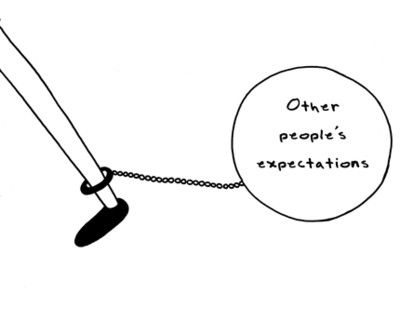
There’s a lot of college students who wander through college trying to figure out what major to pick. While this decision can be overwhelming, it may be easier than you think. Instead of becoming a lawyer, like your father was, instead of studying business to take over the family company, why not study what you love?

There’s a story I once heard about a woman who really had a way with animals. All through her life, people would tell her she needed to become a veterinarian because she was so good with animals. After this conditioning her entire life, when she got to college, she naturally decided to become a veterinarian as everyone had expected and encouraged her to become. After graduating and starting her career as a vet, she found herself absolutely miserable. She wasn’t happy being a vet. After stripping away other people’s expectations for her and some thoughtful soul-searching, she discovered what her true passion was and changed her path.

By and far, the people who seem to have the best college experience are currently studying or majoring in a field that they feel strongly about. The answer for deciding your college major may be this simple: study what you love.

Here are some examples from students on Tumblr who are studying what they love:

  1. Audrey is studying criminal justice, wants to work for the NYPD and says, “I want to do something to help communities.”
  2. Syll is studying to become a doctor and work in the medical field. She decided on pre-med “Because since I could remember I wanted to help people and save lives. Truth is, biology is not easy, science is not easy, and mathematics is not easy. Being a Pre med major is lots of work and dedication. While your friends are out having fun catching a movie, you will be home or at the library or with a study group studying.” Despite the challenging nature of her degree, Syll kept focused on her goal to “become a third world country doctor.”
  3. Kara says, “I am majoring in Sociology. I absolutely love the field.”
  4. Says Vanessa Mae, “I just freaking love my photography class. Like, so so so much. I can’t even explain it. This is where I’m supposed to be. What I’m supposed to be doing.

If you’re in the process of trying to decide your college major, look past other people’s expectations of you and concentrate on what floats your boat, what makes you feel empowered, strong, and on top of the world. Chances are you have a natural knack for that and will find a way to succeed.

Popular Search Terms:

college students loving majorhow do i pick my majorhow to pick a collegeHow to pick your majoronline major studyingreasons to love your collegesoul searching college major,

What Makes A Great Nurse?

January 14th, 2011 by Rachel Call

It’s no secret that nurses play a very important role in the care of patients. Among all members of the health care team, the nurse spends the most time with patients. This fact alone gives nurses the unique position of having the ability to improve the quality of care in hospitals, nursing homes, and communities.

Whether you are still in nursing school or presently working as a staff nurse, you always aspire to improve yourself and become a great nurse for your patients. Here are some of the qualities that can make you a great nurse who is valued by both your team and your patients.

Empathy
Every nurse must possess genuine empathy towards their patients in order to excel on the job. If you do not have compassion and a caring attitude, then you will not go far in your nursing career. How can you establish rapport with a patient if you don’t really care about his or her feelings? If you don’t have a caring attitude then your patients will not cooperate with you and your efforts to improve his or her health will not be effective. Of course, some can fake it and be that “nice” nurse. But somehow this facade will break down and rear its ugly head in your sloppy, careless, inconsiderate work.

Patience
Nursing is a tough job. You will encounter demanding patients, obnoxious doctors, and incompetent colleagues. But remember, you come to work because of the patient and should keep your emotions in check. It does not mean you transform yourself into a robot; we are human beings and showing our emotions is normal. Just make sure those emotions don’t get in the way of doing your job as a nurse. The health care workplace can be brutal, but having lots of patience helps you survive the day without incident.

Competence
No amount of empathy and patience can substitute for pure competence and intelligence. If patients have their say, they will always choose the most knowledgeable and experienced nurse. Just by being competent and doing the job well, you will inspire confidence in your patient, and this will likely result in a better relationship. Start honing your skills in nursing school and continue increasing your competence as a nurse as you continue on your career path. Your patients will be thankful that the nurse entrusted with their care is skilled and knows his or her stuff.

Dependability
A highly-skilled nurse who is lackadaisical or who is always late for the change-of-shift report is not a great nurse. Even if that nurse is extremely competent and knows all the nursing tasks and lab values like the back of his or her hand, but can not be counted on, then he or she values neither the team nor the patient. As a nurse, make sure dependability becomes one of your great assets. Over time, patients and your team will value you more and more, and that can open up additional opportunities for you.

Hunger for Knowledge
By becoming a nurse, you pledge to become a life-long learner. It is imperative that you grasp this fact early in your nursing career if you are in this for the long haul. Health care, nursing knowledge, and medical science are constantly evolving and changing very rapidly. You need to make sure you keep up with all the changes because ignorance can be dangerous. You need to be able to quickly learn all the new medical gadgets and equipment out there. Don’t forget your obligation to complete continuing education units to renew your license and update your knowledge.

Good Role Model
Imagine a nurse conducting a smoking cessation seminar who takes a puff of smoke during breaks. Or a nurse with wild, unkempt hair and dirty fingernails giving hygiene tips to a senior. Surely, these nurses’ behavior and appearance defeat the purpose of encouraging healthy habits. A great nurse always walks the walk. Yes, it is hard to be the next Florence Nightingale, and we all have our shortcomings. But that should not make you stop trying to become a good role model.

Prideful
A great nurse takes pride in his or her work and for good reason. As a nurse, you are a valuable member of the healthcare team. You are a great resource not just in your workplace but also to the larger community given your knowledge and expertise. You have the opportunity to make a real difference in the lives of your patients and their families. For years, nurses have been identified in surveys to be the most trustworthy among all professionals.

A great nurse puts himself or herself in the patient’s shoes and is always there to address the patient’s needs. By staying competent and learning continuously, a great nurse will always be valuable to the patient and the health team. Lastly, a great nurse takes pride in his or her work and always strives to become a good role model. Now that you know the qualities of a great nurse, are you ready to become one?

J.G. Enriquez has worked as a nurse for 4 years. He writes feature articles about careers as a Registered Nurse, like the one you have just read, for BrainTrack.com.

Popular Search Terms:

what makes a great nursenurse shift reportwhat is a great nursing rolewhat make you a valuable member of the nursing team?a good role model as a nurseWhat makes a great nurse?what makes an amazing nursewhat makes nursing teamyou always aspire to improve yourself and become a great nurse for your patientsvalues of a great nursetransforming your self in to a nurse who care?Role of Emotions in Nursingqualities of a great nursenurses pride in their workplacemy colleges and careers nursingjgenriquezhow to really be a great nurseblogs:my career path as a nurseyou are a great nurse,

10 New Ways to Cook a Turkey

November 24th, 2010 by Rachel Call

On Thanksgiving day, people across the country sit down to a turkey dinner. Whether it is grilled, roasted, or even deep friend, turkey is a staple on this day of gratitude.

If you feel like changing things up this year and decide to try something a little more gourmet than a regular roasted turkey, here are some ideas to get you started.

  1. Smoked Turkey: If you don’t have a water smoker, you can still enjoy this delicious turkey recipe using your barbecue grill. Using hot briquettes and hickory chunks, but not directly under your turkey, you’ll have tender meat in no time.
  2. Grilled Turkey: Use your barbecue grill in the traditional way and thaw your turkey, add some seasoning, and grill your bird to perfection, turning it constantly.
  3. Deep Fried Turkey: This succulent turkey recipe is very quick. After your turkey is thawed you will lower it into hot oil and fry it for about 3 minutes per pound.
  4. Steamed Turkey: To steam your Thanksgiving feast, you will remove the turkey from the bones and cook it over boiling water. This technique retains most of they turkey’s nutritional value.
  5. Brined Turkey: Bringing your turkey will make it very moist. For this recipe you will allow the turkey to soak in a salt-based mixture before cooking it.
  6. Marinated Turkey: Similar to brined turkey, marinated turkey is soaked in a mixture before cooking. There are various marinade recipes that will give your turkey an amazing flavor.
  7. Injected Turkey: Injecting your turkey is a great way to add some flavor. You’ll create a mixture with a recipe then use a cooking syringe to insert the mixture inside the bird before cooking.
  8. Crockpot Turkey: If you’re the type of cook who likes to start something, then let it finish on it’s own, a crockpot turkey is for you. Add some seasonings, vegetables, and come back to your mouth-watering turkey.
  9. Glazed Turkey: This easy recipe involves cooking a delicious glaze to brush over your turkey during the roasting process.
  10. Crusted Turkey: To make crusted turkey, you will remove the turkey from the bone, make a bread crumb mixture to coat the meat with, then bake the turkey.

Popular Search Terms:

10 top ways to cook a turkey,

Ten Questions To Ask Yourself When Picking A Major For An Online School

November 20th, 2010 by michaelm

When you are getting ready to go back to school at an online school, you will find that you have hundreds of options for a major. Depending on the major that you select, you may actually decide to attend an online school that specializes in an area of study. A good example of this would be healthcare majors. There are many online schools dedicated to medical careers and if you opt to major in one of these areas it might be best to pick a specialty school.

Here are ten questions to ask yourself when you are picking a major for an online school. Answering these questions honestly will help you to determine the best area of study for your situation.

1.) What do you like and when you were in high school, what areas interested you and what classes did you enjoy the most?

2.) What type of career would you like to have after you graduate?

3.) Do you want to take classes entirely online or would you like to have some actual classroom experience?

4.) How long do you want to be in school? Keep in mind that completing a Bachelor degree will take twice as long as completing an Associate Degree. A certificate program will likely take only a few months to complete.

5.) How much do you want to earn from your new career?

6.) Where are your weak spots and what type of classes and subjects present you with difficulty?

7.) How much time will you have available for studying and completing your coursework?

8.) What type of personality do you have and do you enjoy working alone or with many people? Do you want to interact with the public daily or would you prefer to work alone in an office?

9.) What are the requirements for the major?

10.) Are there several majors that will support your career choice? If so, what are they and which is the best fit for you?

Popular Search Terms:

selecting a major online10 questions to ask a collage attendant if there major is art10 questions to ask yourself about your majorquestions in picking your college degreetop 10 questions asked about your college majorwhat to ask yourself when picking a major?who to ask for school major,

Ten Tips On Picking A Major At An Online College

November 20th, 2010 by michaelm

Starting or returning to college is an exciting time of life, all the more when you chose a major that motivates you. Some students are confused and bemused with an overwhelming selection of college majors, making a choice of one a shaky decision. To clear your mind and strengthen your judgments, simply apply these top ten tips to choosing the college major you are most suited to succeed in.

1. Skills and Talents.
The most popular college majors are not for everyone, so be sure to choose according to your own evaluation of your special talents and skills. This may lead you toward writing courses, speech, athletics or theater, just be sure you are passionate about the subject matter.

2. Salary Surveys
To reach your target earning capacity, you may need to research a few college majors for entry level salaries, promotional possibilities and extended pay with a post graduate degree.

3. Watch the Prerequisites
When selecting your college major, be sure to take note of what prerequisites are mandated for certain career paths. If you have an aversion to math, then you may opt to pursue a major with minimal mathematical requirements or perhaps a line of study that just requires a statistics class.

4. Future Degrees
When you are at the two or four year degree level is the time to ponder the idea if you will wish to pursue post graduate work. Not every major may be extended to a Masters or Ph.D level, so plan your work and work your plan when you begin your undergraduate courses.

5. Easy Does It
Going back to school is a milestone achievement regardless of what you choose to study. However, some students prefer to take a major that seems to be easier and less time consumer to attain. If you are short on time to study, try a liberal arts major that appeals to you and does not require heavy math or science courses.

6. Foreign Languages
Students that have some bilingual skills may opt to major in their area of expertise. If you can speak some Spanish, German or French before your classes begin, you are already ahead of the game and will certainly do well in your foreign language major.

7. Cost Efficiency
To save time and money, try selecting a major with a minimal amount of units to be fulfilled or opt for a standard B.A. rather than the B.S. degree which can have more units required.

8. Specialty Fields
Unusual majors in specialty fields can be a gold mine to the savvy student when its time for graduation and employment. The hiring and competitive edge may be narrower for a graduate in a unique field such as aviation, radiology or the travel industry.

9. Research the Required Courses
You will do well to look ahead at what is down the road with each major’s coursework and graduation requirements. You may browse the university’s course catalog to ensure the following year’s courses meet with your approval and you enjoy the subject matter. Students do the best when they like what they study, so be sure to jump a head to learn all you are responsible for to graduate. Education is one place where you don’t want any surprises, so be sure you have researched your major through the final year of graduation.

10. Your Decision Alone
Too often the first time college student is bombarded with kindly advice from well-meaning people, however, you are the one that must complete the college work and you must be comfortable in your own skin. Yes, take their suggestions, but never let another individual make the decision for you about what you are going to study. Its your life, hard work and joyous reward to get to the finish line as you see fit.

Popular Search Terms:

tips on picking course in college,